The RQI Revolution: Best RQI Providers, Criticism, and Praise

Why instructors criticize station-based CPR training
Criticism usually begins with what a learner sees during the hands-on station: measured rounds of adult and infant chest compressions and bag-mask ventilation, completed without a live instructor at the learner's side. Some members of the instructor-led training community believe that experience can feel too narrow when an ACLS or PALS learner expects live team communication, role assignment, airway decisions, rhythm-based scenarios, or a full megacode.
An experienced instructor can watch how a learner reacts under pressure, answer an unexpected question, connect a correction to a real clinical situation, and adjust coaching in the moment. A self-directed station can give immediate performance data, but it cannot reproduce every human conversation or team interaction. This concern is especially important for new clinicians who may need more context than an experienced resuscitation team member.
Other criticisms focus on implementation rather than the educational model itself. Instructors have described learners encountering equipment problems, unclear room-access instructions, limited help when a station does not behave as expected, or facilities whose cleanliness and privacy vary. There are also concerns about identity verification and whether an unsupervised learner could receive help from someone else. Those are legitimate oversight questions, but anecdotal concerns should not be presented as proof that misconduct is widespread.
Marketing can create another problem. A learner may think they are buying quarterly RQI, an online-only HeartCode course, HeartCode Complete with hands-on testing, or an instructor-led course when the product is actually something different. Confusion about the credential, total price, skills format, employer acceptance, or available support can turn a valid AHA pathway into a poor customer experience.
RQI and HeartCode Complete are not the same program
This distinction resolves much of the confusion. The official AHA Resuscitation Quality Improvement program is a low-dose, high-frequency performance-improvement system. Learners complete quarterly cognitive and psychomotor activity and maintain an active quarterly RQI eCredential. The current program names are RQI BLS Provider, RQI ALS Provider, and RQI PALS Provider.
HeartCode Complete is a different pathway. It combines online cognitive coursework with hands-on skills completion and provides a two-year AHA BLS, ACLS, or PALS eCard. Public training providers often use RQI or CPR Verification Station technology for the hands-on portion of HeartCode Complete. People commonly call that an “RQI class,” but the credential and renewal cycle are different.
The online portion also matters. HeartCode ACLS and PALS cover algorithms, rhythm recognition, medications, clinical decisions, and team concepts through interactive learning. The precise criticism is therefore not that the complete pathway contains no clinical content. It is that objective CPR-skills verification does not replace every benefit of live team practice, local mock codes, or individualized instructor coaching.
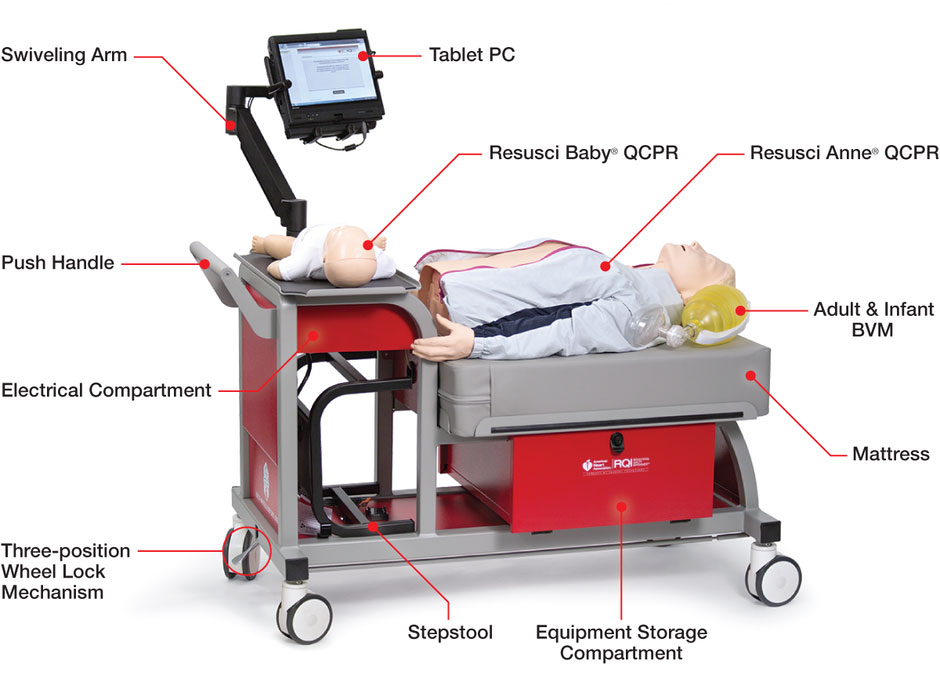
An RQI simulation station measures adult and infant CPR and ventilation performance and supplies real-time feedback.
What the newest hospital-outcomes study found
A 2026 observational study in JAMA Cardiology examined 237 hospitals and 49,870 in-hospital cardiac arrests. Researchers matched 18 hospitals that adopted RQI with 107 control hospitals. During the two years after implementation, RQI adoption was not associated with improved survival to discharge or return of spontaneous circulation compared with the controls. The authors concluded that a program focused on CPR delivery alone may not be enough to improve hospital survival.
That result should be interpreted carefully. It does not show that RQI caused worse outcomes, and an observational hospital-level study cannot isolate every part of a resuscitation system. It does show why training claims should stay precise: better skill measurement or retention is not automatically the same as a proven improvement in patient survival. Read the study abstract and methods on PubMed.
The strongest benefits of RQI and station-based HeartCode Complete
Frequent practice addresses skill decay
The 2025 AHA Guidelines for resuscitation education note that CPR skills can begin to decay within about three months. Quarterly RQI activity directly addresses that problem by replacing a single two-year training event with recurring practice and assessment.
Objective measurement and immediate feedback
Feedback technology measures elements such as compression rate, depth, recoil, and ventilation performance. The learner receives audio and visual guidance immediately and repeats the activity until the performance standard is met. This reduces variation caused by one evaluator accepting a skill that another evaluator might reject. The 2025 AHA education guidelines recommend CPR feedback devices during skills training because they improve performance.
Mastery learning instead of one-time exposure
RQI uses deliberate practice and mastery learning: the learner receives a result, makes a correction, and tries again. That loop can build muscle memory and confidence more effectively than merely completing a course on a calendar. Standardized measurement also lets a large health system apply the same performance threshold across departments and locations.
Flexible access for clinicians and employers
Self-directed stations can be available around the clock. Clinicians can train around a shift instead of waiting for a scheduled classroom, while hospitals may reduce backfill, travel, and time away from patient care. Public HeartCode Complete providers can offer similar scheduling flexibility for learners who need a two-year AHA eCard.
Adaptive learning, analytics, and current science
Current programs use adaptive digital learning and provide administrators with data on completion and measured competence. RQI Partners' 2025 Guidelines FAQ states that its programs transitioned to 2025 AHA Guidelines science by January 1, 2026. Organization-level analytics can identify overdue learners, recurring skill gaps, or units that need additional support.
A platform that can be strengthened locally
Technology and instructors do not have to be rivals. A strong program can combine frequent objective CPR practice with live mock codes, team-based scenarios, instructor coaching, reliable equipment checks, and local quality review. The station is most useful when an organization understands what it measures well and deliberately supplies the team training and clinical context it does not attempt to replace.
How to choose an RQI or HeartCode Complete provider
- Confirm the exact product. Ask whether you are purchasing quarterly RQI, HeartCode online-only, HeartCode Complete, or an instructor-led course.
- Confirm the credential. Determine whether you will receive an active quarterly RQI eCredential or a two-year AHA BLS, ACLS, or PALS eCard.
- Check employer acceptance before paying. Employers may have specific rules about course format or additional team training.
- Verify 2025 science. Ask whether the assigned course and station content reflect the 2025 AHA Guidelines.
- Compare the total cost. Include online coursework, hands-on testing, retesting, cancellation, and card fees.
- Ask about support. A good provider clearly explains access, offers timely help, and has a plan when equipment or software fails.
- Evaluate the facility. Look for a clean, private, well-maintained station with transparent entry and safety procedures.
- Know what is assessed. If you want live scenarios, megacode practice, or instructor coaching, confirm that those elements are included instead of assuming.
Best RQI-Technology and HeartCode Complete Providers by Metro
The providers below are our 2026 editorial selections for learners seeking HeartCode Complete or related station-based services. The top picks were evaluated on communication, service, speed, quality, and cleanliness; affordability is also part of the Thri selections. These are editorial choices, not third-party awards. Course format, price, availability, and employer requirements can change, so verify the details before purchase.
Nashville, Tennessee
Top pick: Thri Nashville. Our selection for communication, service, speed, quality, cleanliness, and affordability.
Other local options found during research include CPR Lifeline and Citywide CPR.
San Antonio, Texas
Top pick: Thri San Antonio. Our selection for communication, service, speed, quality, cleanliness, and affordability.
Other local options found during research include CPR Cart and Citywide CPR.
Phoenix, Arizona
Top pick: CPRVAM. Our selection for communication, service, speed, quality, and cleanliness. CPRVAM's course buttons lead to its discipline pages; its Phoenix location page confirms local availability.
Other local options found during research include CPR Cart and AZ ACLS.
Boise, Idaho
Top pick: CPRVAM. Our selection for communication, service, speed, quality, and cleanliness. CPRVAM's course buttons lead to its discipline pages; its Boise location page confirms local availability.
Another local option found during research is CPR Cart.
Las Vegas, Nevada
Top pick: CPRVAM. Our selection for communication, service, speed, quality, and cleanliness. CPRVAM's course buttons lead to its discipline pages; its Las Vegas location page confirms local availability.
Other local options found during research include CPR Cart and Project Heartbeat.
Atlanta, Georgia
Top pick: Thri Atlanta. Our selection for communication, service, speed, quality, cleanliness, and affordability.
Other local options found during research include CPR Cart and Criticare Medical.
Dallas, Texas
Top pick: Thri Dallas. Our selection for communication, service, speed, quality, cleanliness, and affordability.
Other local options found during research include CPR Cart and Citywide CPR.
Philadelphia, Pennsylvania
Top pick: Thri Philadelphia. Our selection for communication, service, speed, quality, cleanliness, and affordability.
Other local options found during research include CPR Cart and NIEC.
Washington, DC
Top pick: Thri Washington DC. Our selection for communication, service, speed, quality, cleanliness, and affordability.
Other local options found during research include Code One and CPR Cart.
Tampa, Florida
Top pick: Thri Tampa. Our selection for communication, service, speed, quality, cleanliness, and affordability.
Other local options found during research include Safety Training Seminars and Citywide CPR.
The bottom line
RQI addresses a real problem: lifesaving skills can decay long before a traditional two-year card expires. Frequent practice, adaptive learning, objective feedback, flexible scheduling, and performance data are substantial advantages.
The instructor-led community is also right to insist that measurable CPR technique is not the whole of resuscitation readiness. Teamwork, clinical integration, human coaching, reliable equipment, appropriate support, and a complete system of care still matter. The best question is not whether technology or instructors should win. It is whether each learner and organization is using the right combination of tools to produce competent individuals, coordinated teams, and better care when a real emergency occurs.
Provider availability, prices, hours, course formats, and employer acceptance may change. Verify all requirements and current terms before purchasing.
Primary sources and further reading
- American Heart Association: Resuscitation Quality Improvement Program
- RQI Partners: RQI program overview
- RQI Partners: HeartCode Complete
- RQI Partners: Simulation Stations
- RQI Partners resources and evidence library
- 2025 American Heart Association Guidelines for CPR and ECC
- 2026 JAMA Cardiology study of RQI adoption and hospital cardiac-arrest outcomes